
The Day Ada Acker Chose Tomorrow
How a Lunenburg widow survived typhoid fever in 1899 and shaped my family’s future

When typhoid fever swept through a Nova Scotia fishing village in 1899, Ada Acker Nowe lost her husband, her daughter, and nearly everything she knew. What she chose next didn’t just shape her own survival—it reshaped generations. This is the story of a widow who chose tomorrow, and the legacy that followed.
The First Storm: Typhoid Fever
First South, Lunenburg County, Nova Scotia, 1899
By the second week of October 1899, death had entered the Nowe household and refused to leave. Typhoid crept from room to room, sparing no one in its path. Just a week earlier, the Bridgewater Bulletin newspaper had reported that, although the fever was spreading through the county, no deaths had yet been recorded.
Now, there were two.
Ada’s husband, Levi Nowe—a fisherman who had weathered countless Atlantic storms—succumbed to typhoid on October 10. Days later, their teenage daughter, Cordelia Floreska (Della), followed him. Ada sat between the sickbeds, dizzy with fever herself, wondering how an illness that had barely touched the town could suddenly claim her home.
Even after the burials, the fever lingered. Their house in the settlement of First South stayed shuttered, its windows dim, the air thick with sickness and grief. Word spread quickly: the Nowes were still down—eleven children, an aging grandmother, and Ada, now a widow.
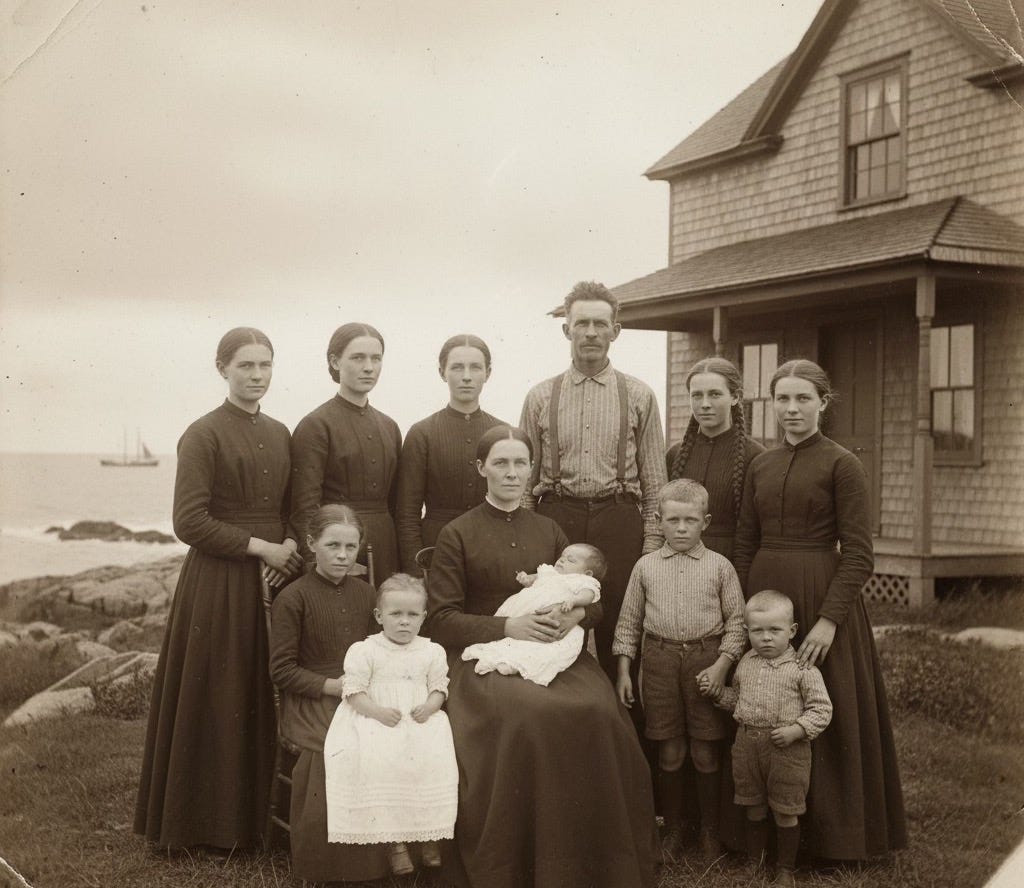
Whispers travelled faster than the illness. Some neighbours said the family had been “brutally treated” by those around them, left to fend for themselves when they most needed help. Others simply turned away. Ada must have felt the sting of it—gossip and pity she hadn’t asked for. In one week, she had buried her husband and her daughter, and still the fever burned through her remaining children. There was no time to grieve.
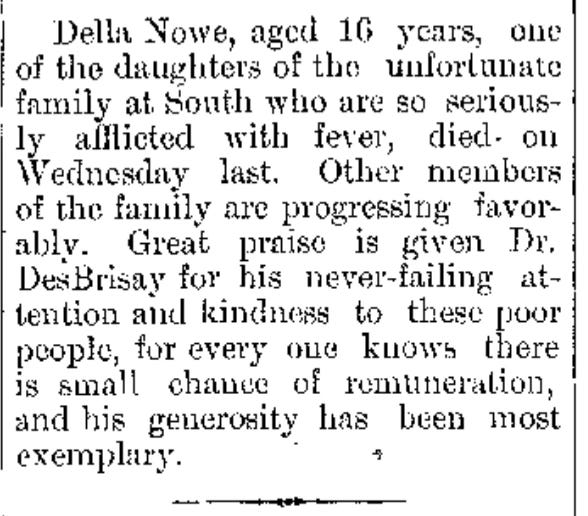
When Dr. Thomas DesBrisay finally made the journey from Lunenburg township to First South, he found the family in a desperate state. He moved from bed to bed, taking pulses, cooling fevered skin, mixing medicines. The Bridgewater Bulletin later praised him for his “never-failing attention and kindness to these poor people,” noting that “everyone knows there is small chance of remuneration.” His generosity, it said, was “most exemplary.”
The doctor brought medicine, but Ada brought something more enduring—a strength inherited and honed across generations.
Weathering the Early Years
Ada Augusta Acker was born around 1858 in Lunenburg County, Nova Scotia, the daughter of Benjamin Acker and Anna Sophia Weinacht. My third great-grandmother, she was a woman whose courage would echo through generations. A descendant of the German Foreign Protestants who had settled along the South Shore, she came from a lineage of people who carved farms and fishing coves into the rocky coastline. From this heritage, Ada inherited a profound strength: a life shaped by work, endurance, and faith in the face of hardship.

On March 23, 1878, she married Levi Nowe of First South, and together they raised eleven children. Life on the coast was unforgiving—each day dictated by the wind, the tide, and the mood of the sea. Superstition in Lunenburg ran as deep as its waters: it was said that only white mittens could be worn at sea, for any other colour might invite a storm or bad luck.
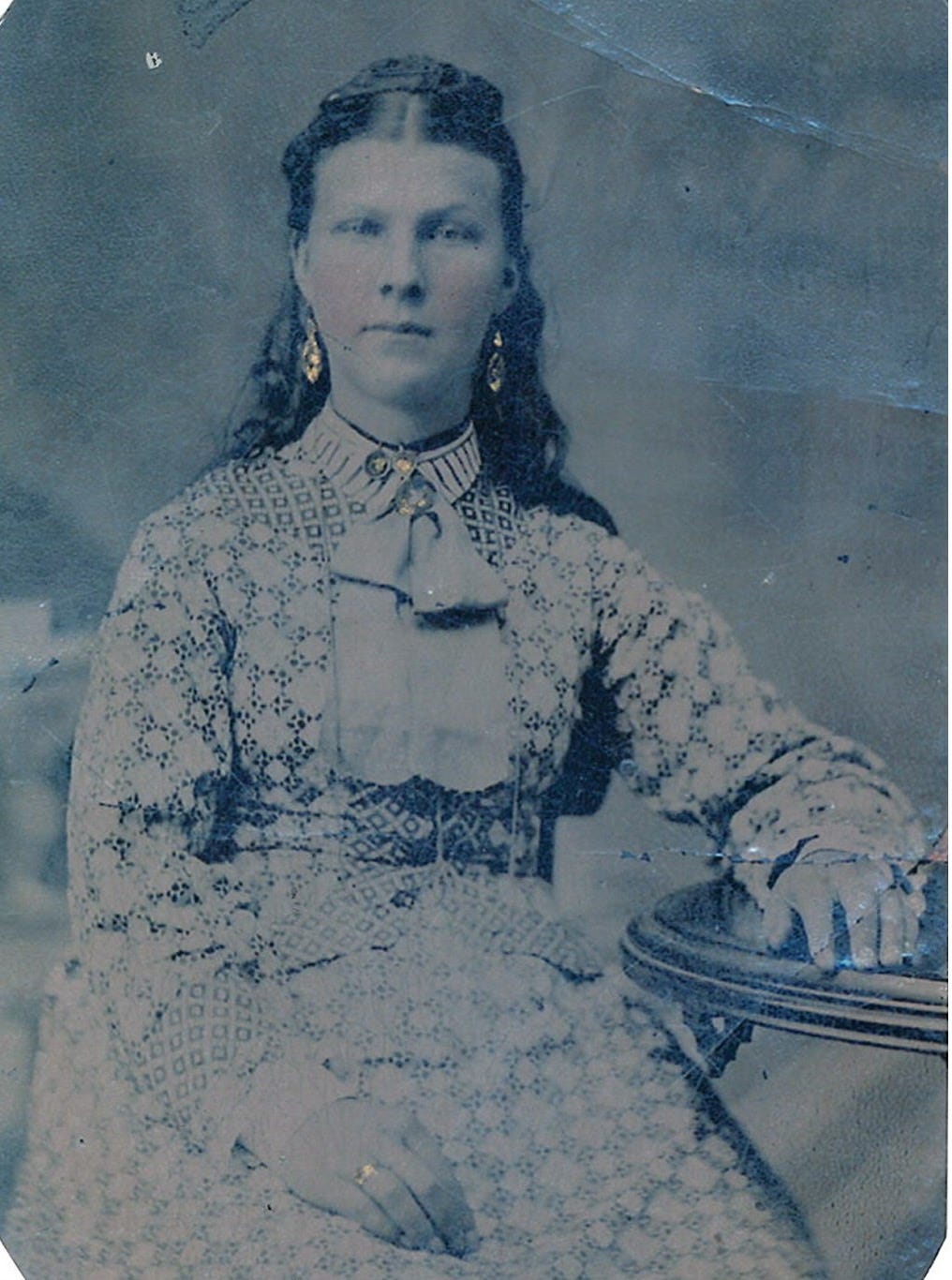
Yet even within these rules, Ada’s elegance shone through. Her children—Bertha Jeanetta, Lavinia May, Cordelia Floreska, Luetta Artie, and Ethel Drusilla, among others—bore names that were both lyrical and intentional, each carrying hope for the future.
Before typhoid came, Ada was already the anchor of her family. Her hands were never still, her eyes always scanning the horizon, attuned to every shift in wind or weather. But even she couldn’t see the storm that was already on its way.
Crosswinds: The Almost-Marriage
Months after typhoid fever had gutted her household, a familiar figure drifted back into Ada’s life. Edward Alexander Tanner had once lived nearby in First South—a younger man who had watched her family’s life unfold from a neighbouring property. By 1900, he was a fisherman in his early thirties, steady on his feet and sure in his manner. He was the kind of man who could cut through loneliness simply by appearing at the door.
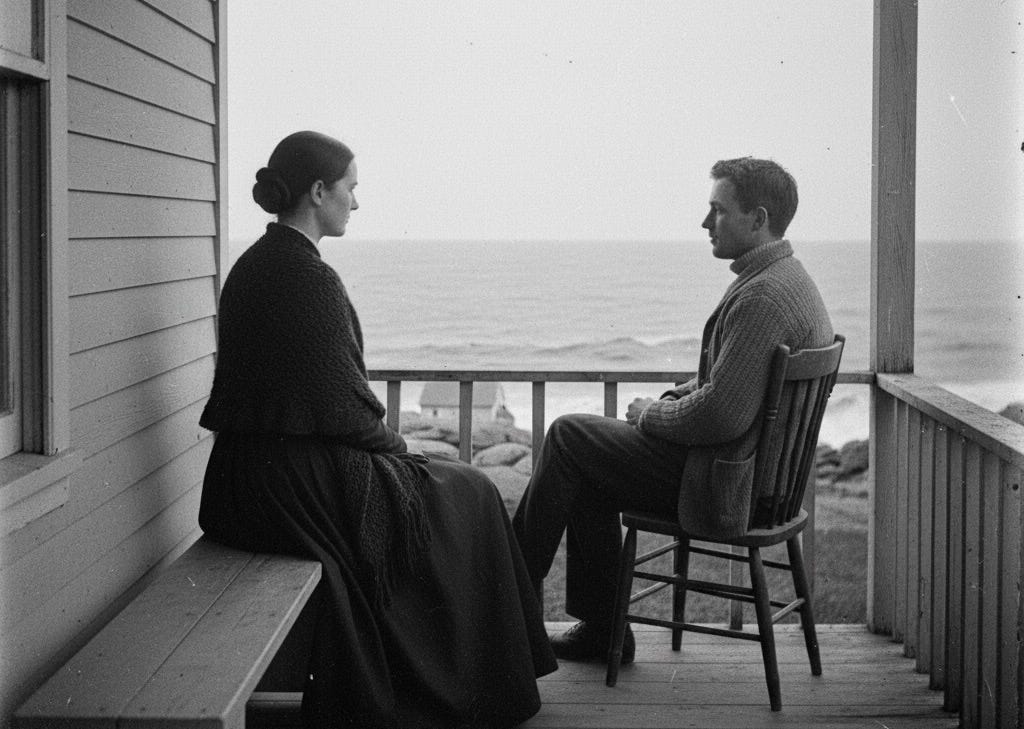
There must have been a spark between them—something unexpected that caught light amid the wreckage of her sorrow. He made her smile again, reminding her what companionship could feel like after so many months of grief. In time, he asked her to marry him, and she said yes.
For a moment, it seemed she might reclaim her life—not as a widow, but as a woman stepping toward something new. The proof still exists: their names, written side by side on a marriage document dated November 15, 1900, the ink dark and deliberate—until it wasn’t. The record bears the faint traces of a plan that was never meant to be, an attempt to undo what might have been.

What changed between them is lost to time. Perhaps she saw something she couldn’t live with, or simply realized her future needed to be her own. Whatever the reason, the wedding never happened.
Less than a year later, Edward Tanner married someone else—Bessie May Nowe, barely twenty, and the niece of Ada’s late husband, Levi Nowe. Life in First South was small, and stories like theirs had a way of traveling fast.
A new storm gathered around her—not of illness or grief this time, but of transformation. It pressed against her and urged her forward, hinting that the life she’d known in First South was ending.
This was the moment Ada chose tomorrow.
Shifting Tides
Lunenburg Township, 1901
Ada’s move from First South to Lunenburg township in 1901 was nothing short of courageous. To leave behind the familiarity of the small world she had always known and step into the pulse of the town required a bravery few women at the time could imagine.
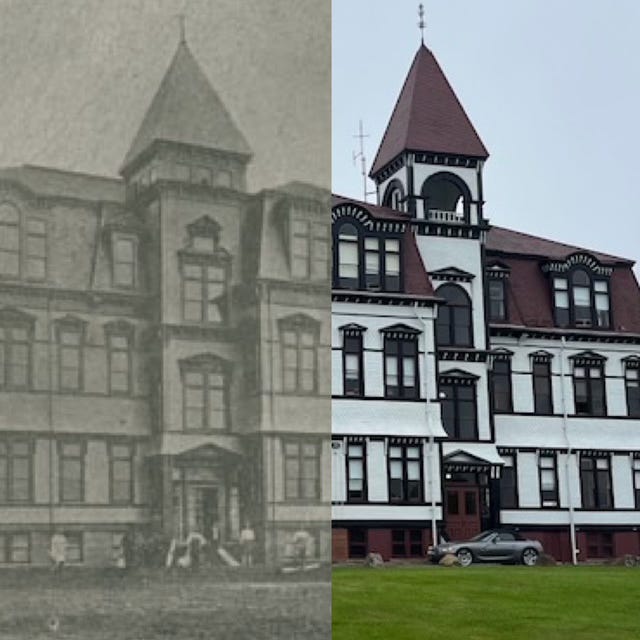
Lawrence Street welcomed her with its tidy houses and the fresh excitement of the newly built Lunenburg Academy across the way—a promise that her children could rise above circumstance through education. The house was alive around her, her family weaving through the rooms like currents, schoolbooks clutched in their hands, the air buzzing with motion and noise, and Ada at the centre of it all.
By day, she laboured as a washerwoman, her hands roughened by water and soap, and yet she thrived in this town, imagining a different kind of life for her family. Even amid the constant demands, there was a thrill to it—the sense that she was no longer confined by the tides or superstition, that here, in the heart of Lunenburg, she was charting her own waters.
Winds of Change
Life moved forward, as it always does. The house on Lawrence Street grew quieter as Ada’s children drifted into their own uncertain lives, carried along by the same tide that had once brought her here.
Bertha Jeanetta, the eldest, had married John Angus Smith and lived nearby in Lunenburg, close to her mother and siblings. In time, she and her husband moved to Halifax, where her name appeared among the dead in the Halifax Explosion of 1917 — a single line in a sea of thousands, yet for Ada’s family, it was a shattering echo.
Lavinia May went to Mahone Bay to work as a domestic. She married Harry Alexander Veinot, bore seven children, and died shortly after the last was born in 1909, with her baby Gordon Clarence surviving only days. (To read more about Lavinia, read A Ghost in Our Roots: How an Ancestor’s Loss Lives in Our Bones.)
Next door to Ada, Lilla Maud raised her young family with her husband, William Acker. Then, quietly, she slipped from the record sometime before 1921, leaving only fragments of her life behind.
Margaret Belle, James Lewis, and Luetta Artie built steadier lives—marrying, raising children, and planting roots. Their stories left no headlines, only traces in records and family memory.
Emily Louisa endured. She married Ervin Hirtle and lived into old age—the last of Ada’s eleven children—passing away in 1975.
Hanson David followed in his father’s footsteps as a fisherman. He enlisted in the Great War in 1918 but was sent home ill before reaching the front. His first wife and small children were killed in the Halifax Explosion. Months later, he remarried Alice Fleet—an effort to rebuild a semblance of home amid all that had been lost. He died at twenty-six of tuberculosis, buried with military honours.
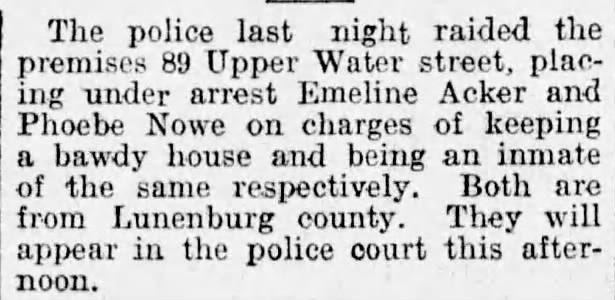
And Phoebe Ann—the restless one. Her name surfaced in the Halifax papers in 1912, arrested in a raid on a Water Street brothel. Perhaps she sought freedom, escape, or simply a place of her own. Whatever she found there, history did not preserve it. After that, she vanished from the record.
Of the youngest, Ethel Drucilla fades from view after 1901—another absence in a family defined by loss.
Through it all, Ada’s presence lingers: her belief in schooling, in decency, and in the quiet dignity of survival. Those acts of courage ripple through each of their stories. They scattered across Nova Scotia, chasing better futures and enduring what they could not change.
By 1915, the house on Lawrence Street had grown silent.
After the Storm
Ada Acker Nowe died at age 57 of tuberculosis, on January 13, 1915. But her life did not end with her passing. Across the decades, the fragments of her courage, her insistence on education, and her determination to carve a better life spread outward—carried not by one child alone, but by generations of descendants who still carry her choices in their veins.
Through them all, Ada’s choice to move to Lunenburg, to fight for survival, and to claim possibility set the course for every life that followed. She chose tomorrow.
And that tomorrow has a name.
In the summer of 2023, I felt the ancestral pull toward Lunenburg. I walked the streets at the heart of the town, unaware at first that I was tracing Ada’s footsteps. I passed Lawrence Street and stepped inside the historic Lunenburg Academy—the same doors, the same stairs where Ada once walked—as if our timelines brushed against one another. I did not see her, and she did not see me, but I felt her there. In the stillness of the streets, in the sounds of the harbour, her choices reached forward, spanning decades, carrying me to that moment.
Before Ada Acker Nowe chose tomorrow, she had to survive today. And because of that, I am here to tell her story.
The storm has passed. The tide has pulled back. And what remains is calm—carrying the echoes of every life she shaped, every sacrifice she made, and the future she dared to imagine.
I too have an ancestor who was a very regular person but gave her children beautiful names. My great-great-grandmother lived in a small village in the Gaspé, but she had been a former school teacher and gave her children names out of romantic French novels: Rodolphe, Lumina, Agnès, Théophile, Ludger...
I loved the split image! I need to incorporate these in my writing!
Great story! We moved from Lunenburg before I was school-aged but my siblings all went to Lunenburg Academy. Also, I think my grandmother trained as a teacher there in around the turn of the 20th century.